.svg)
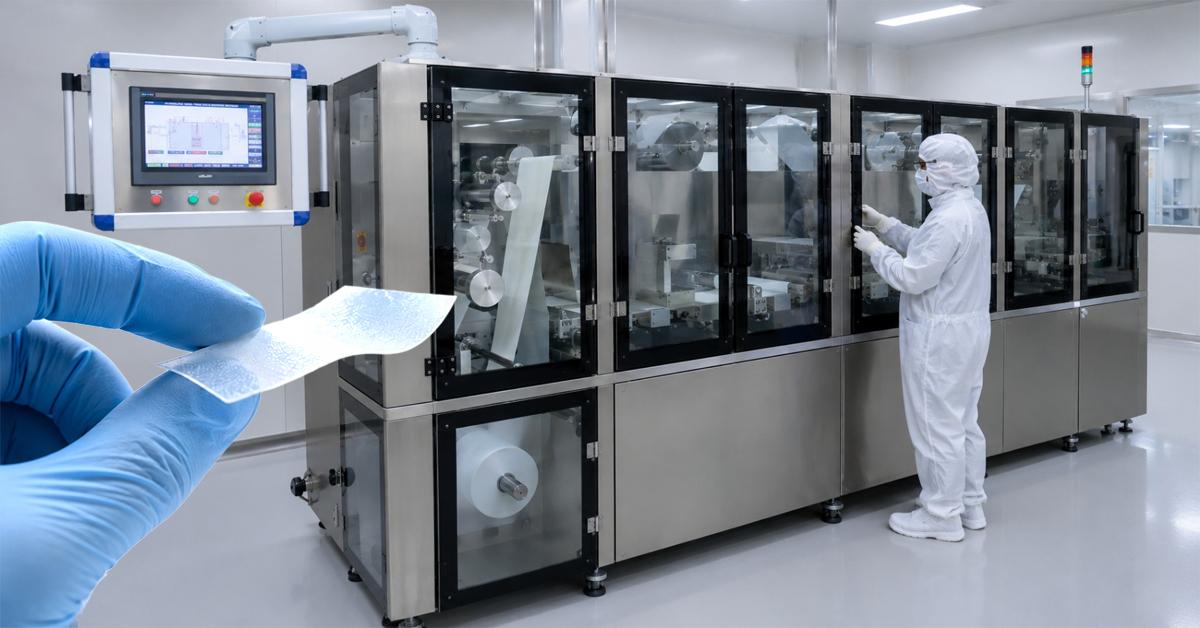
Patient-centric drug delivery is no longer a niche priority. It is reshaping formulation strategy across the pharmaceutical industry. As treatment adherence and ease of administration become more important in therapy design, oral thin films are gaining wider commercial relevance across prescription drugs, OTC products, and wellness applications. This shift is expanding the oral thin film manufacturer from a specialised technology provider to a strategic industrial-scale pharmaceutical partner.
Oral thin films initially gained traction in highly specialised therapeutic segments where rapid administration and patient convenience were critical. Early adoption was concentrated in areas such as antiemetics, CNS therapies, smoking cessation products, and pediatric medicines because these categories benefited directly from fast dissolution and easier administration.
Despite these advantages, widespread commercial adoption remained limited for years. Manufacturing oral thin films required highly controlled formulation environments, specialised coating technologies, and sophisticated drying systems. Many APIs also posed formulation challenges related to taste masking, stability, and dose uniformity. At the time, most pharmaceutical manufacturers lacked dedicated infrastructure for large-scale oral film production, making commercial scalability difficult.
The market began evolving as pharmaceutical companies increased focus on patient adherence and differentiated drug delivery. Dysphagia, geriatric care, pediatric administration challenges, and the growing preference for water-free dosage forms created stronger demand for alternatives to tablets and capsules.
Advances in polymer engineering, precision coating systems, and continuous manufacturing technologies gradually reduced these scalability barriers. Oral thin films gradually moved beyond niche therapeutic use cases into broader pharmaceutical and wellness applications.
This shift has accelerated the growth of the global pharma oral strip manufacturer ecosystem, with CDMOs increasingly investing in specialised oral film capabilities for commercial-scale production.
Oral thin film manufacturing involves the production of thin polymer-based films designed to dissolve rapidly in the oral cavity. These films deliver APIs through buccal or sublingual pathways depending on formulation design and therapeutic intent.
The technology is used across selected prescription and OTC applications where rapid administration, portability, and patient convenience are important.
Oral thin films are particularly relevant for therapies requiring ease of administration, rapid disintegration, and improved patient compliance.
Several converging scientific and commercial developments are driving the rapid growth of contract oral thin film manufacturing globally:
Leading oral thin film manufacturers are now developing multiple film technologies designed for different therapeutic and absorption requirements.
Orodispersible films are non-mucoadhesive films designed to break down immediately upon contact with saliva. These films are broadly categorised into orally disintegrating and orally dissolving formats.
Orally disintegrating films typically carry poorly water-soluble APIs that disintegrate in the mouth before absorption occurs through the gastrointestinal tract. Orally dissolving films generally contain water-soluble APIs that dissolve directly within the oral cavity.
As an oral thin film manufacturer in India, ZIM Labs develops fast-dissolving oral thin films designed to improve patient comfort, portability, and treatment compliance.
Oromucosal films are designed to adhere to the oral mucosa and release APIs gradually through the lining of the mouth. These films are typically placed under the tongue or inside the cheek for buccal or sublingual absorption.
This approach supports systemic drug delivery while bypassing parts of the gastrointestinal pathway, making oromucosal films relevant for therapies requiring controlled absorption and rapid onset.
Leading oral thin film manufacturers are now developing multiple film technologies designed for different therapeutic and absorption requirements. Our article, A Complete Guide to Types of Pharmaceutical Contract Manufacturing gives a broader understanding of how outsourcing models support specialised formulation, development, and large-scale production.
Industrial-scale oral thin film manufacturing requires far tighter process control than conventional oral solid dosage production.
Maintaining uniform API distribution across thousands of thin film units remains one of the most critical manufacturing challenges. Minor coating inconsistencies can directly impact therapeutic performance.
Oral thin films are highly hygroscopic. Exposure to humidity can affect film integrity, dissolution speed, and shelf stability, making specialised packaging and environmental controls essential.
As oral film applications expand, manufacturers are increasingly exploring multi-layer systems and combination therapies. These formulations require advanced compatibility studies and sophisticated process engineering.
Film thickness directly affects dissolution behaviour and API distribution. Precision coating technologies and real-time monitoring systems are therefore essential for commercial-scale consistency.
The modern oral thin film manufacturer has evolved well beyond production. Today, leading manufacturers operate as end-to-end development and scale-up partners across the drug delivery value chain.
Pharmaceutical companies increasingly rely on contract oral thin film manufacturing partnerships for:
Manufacturers with specialised technologies and strong quality infrastructure are becoming increasingly important as oral thin films move toward larger therapeutic and commercial adoption.
Oral thin films are steadily transitioning from specialised delivery formats into broader pharmaceutical applications. Future development is expected to focus on more complex APIs, multi-layer systems, targeted therapies, and personalised dosing strategies.
The technology is also gaining attention across CNS therapies, chronic disease management, nutraceuticals, and lifestyle-focused formulations where convenience and adherence are commercially important.
As this transition continues, the role of the pharma oral strip manufacturer will become increasingly strategic. Manufacturers capable of combining formulation innovation, regulatory readiness, precision manufacturing, and commercial scalability will play a central role in advancing the next generation of patient-centric drug delivery.
ZIM Laboratories Limited is a therapy-agnostic and innovative drug delivery solution provider focusing on enhancing patient convenience and treatment adherence to drug intake. We offer a range of technology-based drug delivery solutions and non-infringing proprietary manufacturing processes to develop, manufacture, and supply innovative and differentiated generic pharmaceutical products to our customers globally. At ZIM Labs, we provide our customers with a comprehensive range of oral solid value-added, differentiated generic products in semi-finished and finished formulations. These include granules, pellets (sustained, modified, and extended-release), taste-masked powders, suspensions, tablets, capsules, and Oral Thin Films (OTF).


