.svg)
Nearly 50% of newly developed drug candidates that progress to the formulation stage exhibit poor water solubility, making it a significant challenge in the development of oral medicines. (Source: IJCPR, 2025.) Poor drug solubility can restrict dissolution in gastrointestinal fluids. This reduces the amount of an API available for absorption and can results in low or variable oral bioavailability.
Nanotechnology is expanding the options available to formulation scientists for addressing some of these limitations. Nano-enabled drug delivery systems, including nanocrystals, lipid nanoparticles and polymeric nanoparticles, can alter how poorly soluble APIs disperse, dissolve, or remain protected within the gastrointestinal environment. Their application in oral formulations is therefore creating new possibilities for difficult molecules during pharmaceutical development, particularly when conventional formulation approaches cannot provide the required exposure.
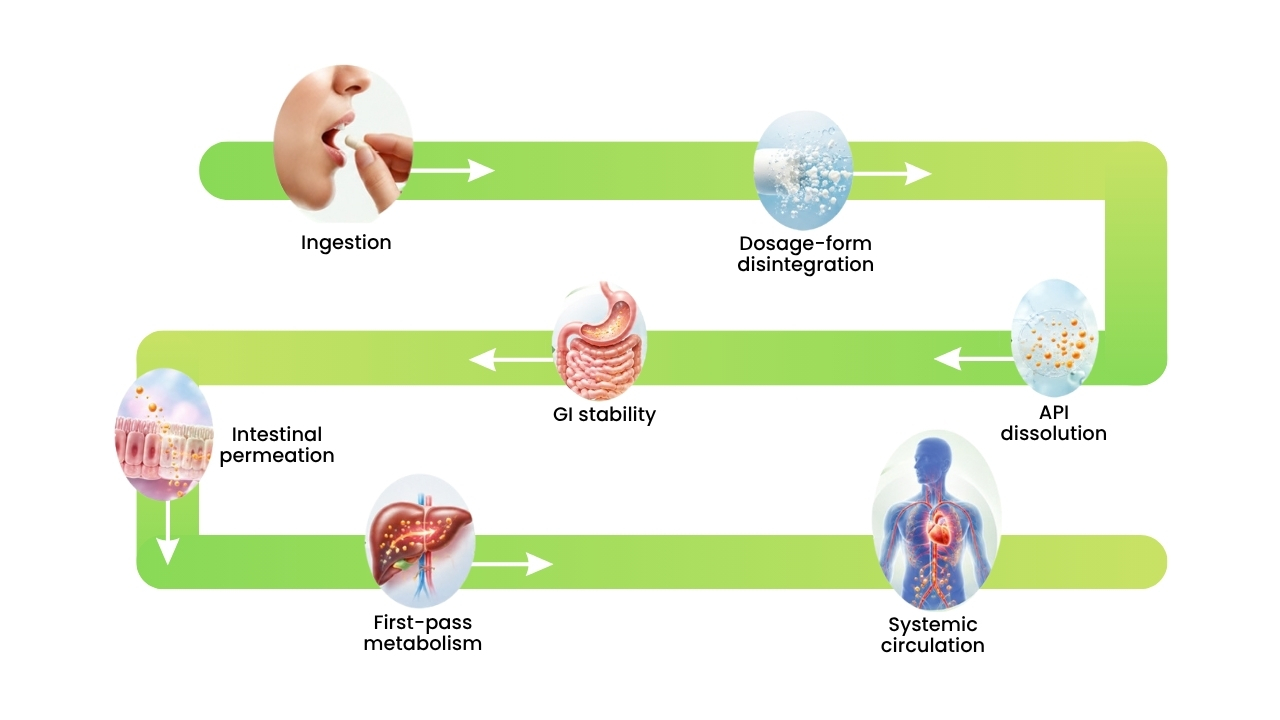
For an orally administered drug to reach systemic circulation, several steps must occur successfully. The API must first be released from the dosage form, dissolve in gastrointestinal fluids, cross the intestinal epithelium, and survive intestinal and hepatic metabolism.
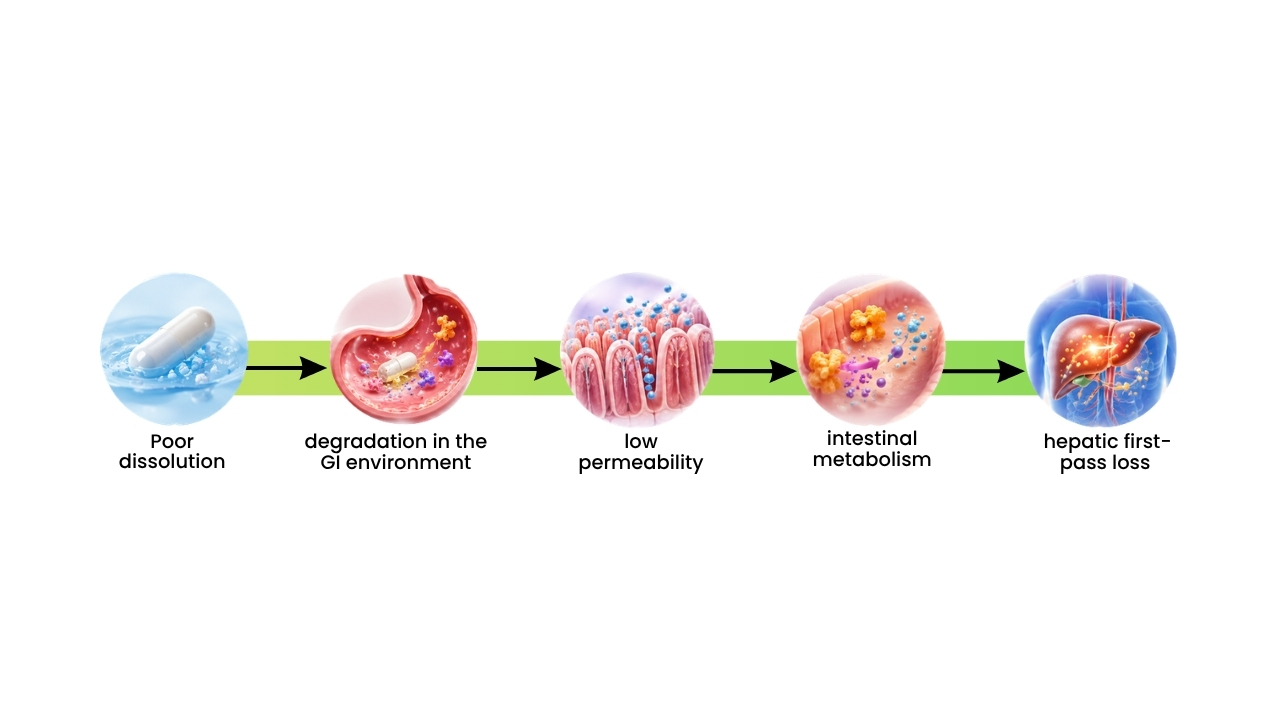
Poor drug solubility can disrupt this sequence at an early stage. If insufficient API enters a solution during its transit through the gastrointestinal tract, the amount available for absorption is restricted. Poor intestinal permeability can further limit uptake. Enzymatic degradation and first-pass metabolism can reduce the amount of unchanged drug ultimately reaching systemic circulation.
The oral absorption pathway can be represented as:
Key bioavailability barriers include:
These limitations are particularly important for BCS Class II and Class IV molecules, where poor solubility is a major development consideration.
Low or variable oral bioavailability can have consequences across the product-development pathway. Formulators may need higher drug loads, additional enabling technologies, or extensive optimisation to achieve the required exposure. This can affect formulation complexity, manufacturing economics, clinical development, and ultimately the commercial feasibility of the molecule.
Nanotechnology approaches the problem by changing how an API behaves within the formulation and gastrointestinal environment. Depending on the platform, this can mean reducing particle dimensions or incorporating the API into a nanoscale carrier. Either this approach can increase dissolution, keep the drug in a more readily available form, or protect it against degradation.
Several platforms are being investigated and applied in drug delivery systems:
Importantly, nanotechnology does not automatically increase the intrinsic equilibrium solubility of every API. In nanocrystal systems, for example, the advantage may instead come from a higher dissolution rate and improved permeation. This distinction is important when selecting an enabling technology during pharmaceutical development.
The growing role of these platforms within India’s formulation landscape is explored further in Future of Oral Drug Delivery in India: Nano-Driven Shift.
The commercial relevance of nanotechnology is strongest where poor physicochemical properties prevent otherwise promising APIs from performing effectively as conventional oral formulations.
In oncology, nano-enabled systems are being investigated for poorly soluble drugs where improving systemic exposure remains challenging. CNS drug development presents similar opportunities because many candidates combine solubility and permeability limitations.
For anti-infectives, improved dissolution and absorption may help optimise systemic exposure for difficult APIs. In metabolic and cardiovascular therapies, long-term oral administration makes predictable exposure and dose efficiency particularly important, another opportunity for nano-enabled delivery.
There is a further lifecycle opportunity. Nanotechnology is not restricted to new molecular entities; existing drugs with recognised solubility and bioavailability limitations may also be candidates for reformulation. This creates scope for differentiated formulations, improved delivery profiles, and product lifecycle strategies built around established molecules.
The performance advantage of a nano-enabled formulation must remain reproducible beyond laboratory scale. Pharmaceutical developers therefore need to evaluate several interconnected factors:
For any pharmaceutical manufacturer, the objective is therefore not to apply nanotechnology wherever an API has poor solubility. It is to determine whether a nano-enabled system can deliver meaningful and scalable improvement over available formulation approaches.
ZIM Laboratories Limited is a therapy-agnostic and innovative drug delivery solution provider focusing on enhancing patient convenience and treatment adherence to drug intake. We offer a range of technology-based drug delivery solutions and non-infringing proprietary manufacturing processes to develop, manufacture, and supply innovative and differentiated generic pharmaceutical products to our customers globally. At ZIM Labs, we provide our customers with a comprehensive range of oral solid value-added, differentiated generic products in semi-finished and finished formulations. These include granules, pellets (sustained, modified, and extended-release), taste-masked powders, suspensions, tablets, capsules, and Oral Thin Films (OTF).


