
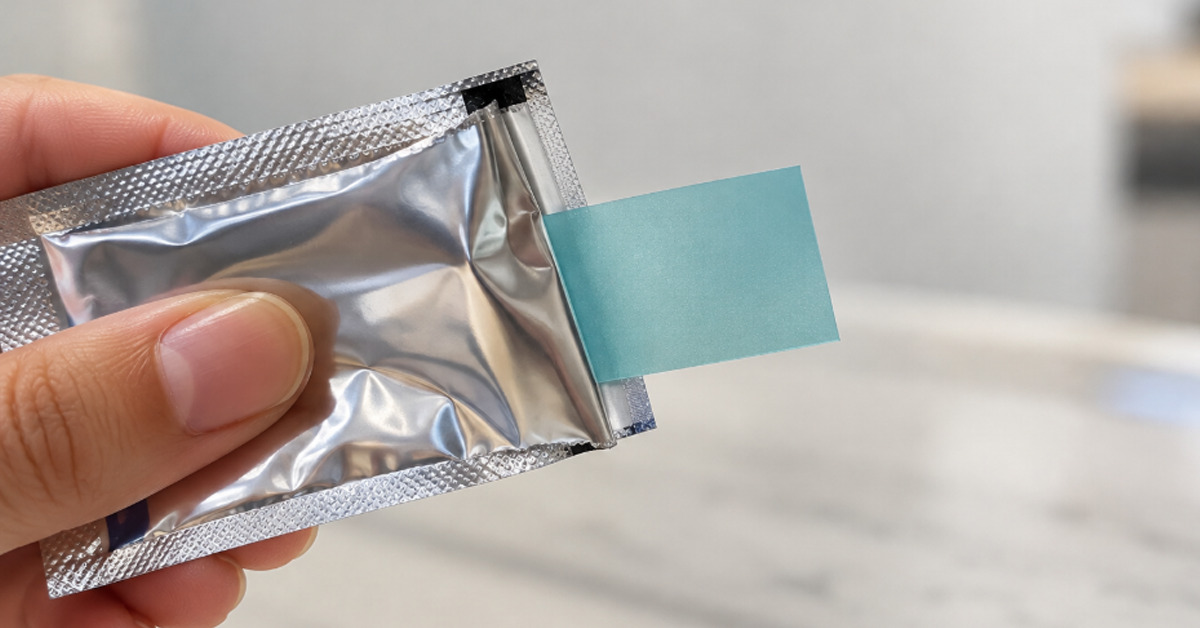
According to the Over the Counter Drugs - Market Share Analysis, Industry Trends & Statistics, Growth Forecasts (2026 - 2031), the global OTC consumer healthcare market was valued at approximately USD 195.96 billion in 2025 and is projected to reach USD 256.18 billion by 2031. As the market expands, pharmaceutical companies are also looking at how dosage-form innovation can make established OTC products easier to carry, administer, and integrate into everyday routines.
This is where the orally dissolving film (ODF) is gaining relevance. Placed in the mouth and designed to disintegrate without water, the format offers an alternative to conventional tablets, capsules and certain liquid or powder products.
But developing an OTC product as a film involves more than transferring an active into a different format. Dose, taste, stability, API properties and manufacturing feasibility all determine whether the concept can work commercially, which is why the choice of oral dissolving film manufacturer matters early in development.
OTC products are often taken without direct supervision from a healthcare professional. How easily a consumer can administer the product therefore matters.
Orally dissolving films can address several practical requirements:
For pharmaceutical companies, the opportunity goes beyond convenience. A film can provide a new delivery format for an established OTC active, creating another route for portfolio differentiation and line extension.
The first question should not be, “Can this product be made into a film?” It should be, “Does a film make sense for this product?”
Four factors are particularly important.
Not every OTC active will pass this assessment. High API loads, difficult taste profiles or stability limitations may make another dosage form more practical.
The formulation possibilities and limitations are explored further in What Can Be Formulated Into Orally Dissolving Strips?
An experienced oral dissolving film manufacturer for OTC products can help pharmaceutical companies answer the feasibility question before significant resources are committed to development.
Development begins by evaluating whether the API, dose, and intended product profile are compatible with a film platform.
This can identify potential challenges involving:
Once feasibility is established, the formulation needs to balance dose uniformity, taste, mechanical strength, disintegration, and stability.
Optimising one attribute can affect another. Increasing API loading, for example, may change film thickness, flexibility, or disintegration behaviour. Development therefore requires the formulation to be assessed as an integrated system.
A successful development batch is only useful if it can be reproduced commercially.
Casting, drying, and other processing conditions can influence film thickness, residual moisture, and product uniformity. The manufacturing process therefore needs defined controls before moving to larger batches.
The oral thin film manufacturer must ultimately establish specifications and controls that maintain consistent performance from batch to batch.
This includes appropriate analytical testing, stability evaluation, process controls, and quality systems supporting routine commercial production.
The next opportunity for ODFs is likely to come from selective expansion rather than replacing conventional OTC dosage forms.
Pharmaceutical companies can evaluate established categories where water-free administration, portability, or easier swallowing creates a genuine advantage. Existing products may also be reformulated as films to create differentiated line extensions without requiring a new active ingredient.
At the same time, advances in areas such as taste masking, polymer systems, multilayer films, and manufacturing technologies could widen the range of feasible product concepts.
This changes the role of the oral thin film manufacturer as well. Pharmaceutical companies increasingly need a partner capable of assessing the concept, developing the formulation, and determining whether it can be translated into reliable commercial production.
Orally dissolving films create an interesting opportunity within OTC product development, but their value depends on product-format fit.
The right API, dose, and use case can benefit from water-free administration, portability, and pre-measured dosing. The wrong candidate can introduce formulation complexity without providing a meaningful consumer advantage.
Working with an experienced oral dissolving film manufacturer for OTC products can help establish that distinction early and move suitable concepts from feasibility through formulation development and commercial scale-up for pharmaceutical companies.
ZIM Laboratories Limited is a therapy-agnostic and innovative drug delivery solution provider focusing on enhancing patient convenience and treatment adherence to drug intake. We offer a range of technology-based drug delivery solutions and non-infringing proprietary manufacturing processes to develop, manufacture, and supply innovative and differentiated generic pharmaceutical products to our customers globally. At ZIM Labs, we provide our customers with a comprehensive range of oral solid value-added, differentiated generic products in semi-finished and finished formulations. These include granules, pellets (sustained, modified, and extended-release), taste-masked powders, suspensions, tablets, capsules, and Oral Thin Films (OTF).


