.svg)
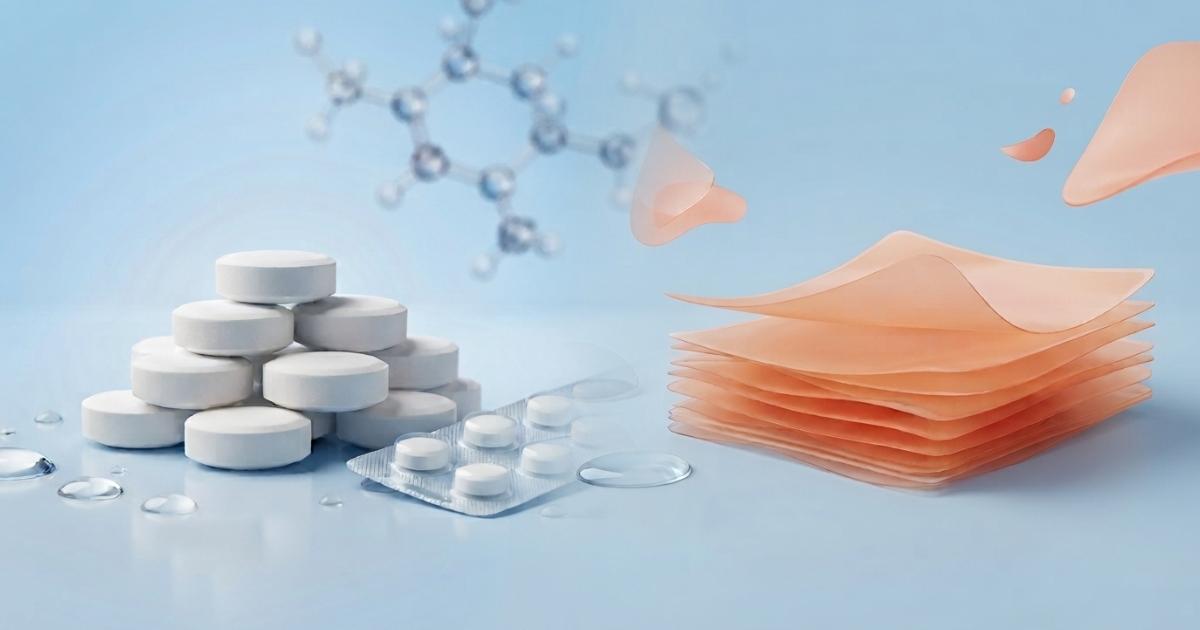
Conventional tablets and capsules remain central to oral drug delivery, but swallowability can limit their suitability for specific patient groups, which is where Orodispersible tablets come in, designed to disintegrate in the mouth without water. Published literature estimates that around 20% of the population experiences physiological or psychological difficulties swallowing conventional solid dosage forms, with the challenge particularly relevant among paediatric, geriatric and dysphagic patients.
Orodispersible tablets (ODTs) and orodispersible films (ODFs) address this limitation through dosage forms designed to disintegrate in the oral cavity without requiring water. However, they are not interchangeable platforms. Their different physical structures influence drug-loading capacity, formulation strategy, manufacturing processes, packaging, and patient experience. Selecting between them therefore requires an assessment of the API, required dose, target population, and intended product profile.
Orodispersible tablets are solid dosage forms formulated to break down rapidly after contact with saliva. The European Pharmacopoeia defines them as tablets intended to disperse in the mouth within three minutes, although many fast-disintegrating tablets are designed for considerably shorter disintegration times. Their tablet architecture provides a comparatively greater scope for drug loading and allows manufacturers to draw on established compression technologies.
Orodispersible films, by comparison, are thin polymeric sheets designed to disintegrate or dissolve rapidly when placed in the oral cavity. Their large surface area promotes rapid hydration by saliva, while the thin, flexible structure can leave little residue after administration. Depending on the formulation and API, the resulting solution or suspension may subsequently be swallowed for gastrointestinal absorption, while certain drugs may also benefit from pregastric or oromucosal absorption.
The structural distinction creates different development considerations:
These differences explain why the growing use of orodispersible films is reshaping medical practice without necessarily replacing ODTs. Each platform addresses a different formulation and commercial requirement.
The principal formulation advantage of orodispersible tablets is their ability to accommodate drug loads that may be difficult to incorporate into a thin-film matrix. ODFs have limited physical volume, whereas the larger mass of an ODT provides greater scope for APIs and functional excipients.
ODTs also benefit from a mature manufacturing base. Direct compression, moulding, spray drying, and lyophilisation are among the technologies that can be used depending on the required tablet characteristics. For a pharmaceutical manufacturer already operating tablet lines, this can offer a more familiar route to scale than introducing specialised film-processing infrastructure.
Their versatility has supported applications across CNS therapies, allergy treatment, pain management, gastrointestinal products and other oral therapeutic categories, particularly where rapid administration is needed or where patients have difficulty swallowing conventional tablets.
Beyond pharmaceutical applications, fast-dissolving formats also create opportunities for super ingredients used in nutraceutical and wellness products, where convenient, water-free administration can add value to the overall product proposition. The suitability of an ingredient for an ODT, however, depends on factors such as required dose, stability, taste profile, and compatibility with the dosage-form architecture.
Taste masking is equally important. Because disintegration occurs directly in the mouth, an unpleasant API can quickly affect acceptability. Coatings, flavour systems, sweeteners, microencapsulation and complexation may therefore form part of the formulation strategy, depending on the API's taste profile.
ODFs approach the same administration problem through a very different physical design. Their thin, flexible construction eliminates the need to swallow an intact dosage unit and reduces concerns associated with tablet bulk or choking. Once exposed to saliva, the hydrophilic polymer matrix hydrates rapidly and releases the incorporated API.
This architecture is particularly attractive for potent, low-dose APIs where large drug-loading capacity is unnecessary. The film's comparatively large surface area can facilitate rapid wetting and disintegration, while its lightweight format makes individual doses discreet and convenient to carry.
ODFs can therefore offer practical advantages for paediatric and geriatric populations, patients with dysphagia, individuals with limited access to water and situations where administration needs to be simple and rapid. Their flexibility and low physical bulk may also make administration easier for patients who resist conventional solid dosage forms.
The advantages come with formulation constraints. Limited film size restricts drug payload, while the API, polymer, plasticiser and taste-masking system must coexist without compromising mechanical strength. Films can also be sensitive to humidity, placing greater emphasis on moisture control and protective packaging.
Newer formulation and manufacturing approaches are expanding what may be possible within these constraints. Developments in functional polymers, nanoparticle incorporation, multilayer films, and 3D printing are being investigated to improve drug incorporation, separate incompatible ingredients, and enable more sophisticated film architectures.
The appropriate platform should be selected on the basis of formulation development rather than on patient convenience alone. Four considerations are particularly important:
Importantly, neither format should automatically be considered pharmacokinetically superior. Although rapid oral disintegration can support faster administration, the extent of pregastric absorption and any resulting improvement in bioavailability depend on the physicochemical properties and absorption pathway of the individual API.
ZIM Laboratories Limited is a therapy-agnostic and innovative drug delivery solution provider focusing on enhancing patient convenience and treatment adherence to drug intake. We offer a range of technology-based drug delivery solutions and non-infringing proprietary manufacturing processes to develop, manufacture, and supply innovative and differentiated generic pharmaceutical products to our customers globally. At ZIM Labs, we provide our customers with a comprehensive range of oral solid value-added, differentiated generic products in semi-finished and finished formulations. These include granules, pellets (sustained, modified, and extended-release), taste-masked powders, suspensions, tablets, capsules, and Oral Thin Films (OTF).


